
What We Call Conflict Is Often Misunderstood: A Public Sector Example
In government, conflict is often treated as something to avoid. But when teams learn to understand conflict styles, structural causes, and the level at which conflict is operating, it becomes easier—not harder—to work together. In this article, Kai Stowers shares how one agency’s experience shows what changes when people finally have the right tools.
Near the end of a daylong offsite with about 80 people from a large state agency, a participant stood up during the group share and said something I won’t forget.
She had spent years judging certain colleagues who handled conflict differently than she did. And after spending the day learning about conflict styles, she said:
“I realized that the people I’ve been judging were trying to do the exact same thing I was trying to do. We were both trying to show respect. We were just doing it in completely different ways. Knowing that makes it so much easier to work together.”
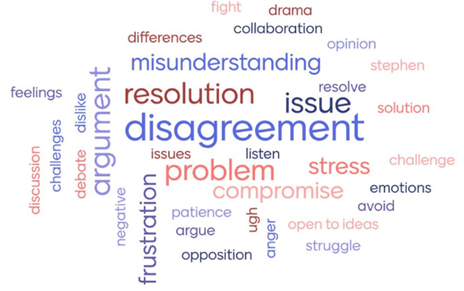
The day started with a question: when you hear the word conflict, what comes to mind? The word cloud the group generated explained why we try to avoid conflict.
Openness to ideas and collaboration showed up too, but they were outliers in a room full of people who had learned to brace for conflict rather than engage with it.
Conflict Styles: When Difference Looks Like Disrespect
We spent the morning on the foundation. I’ve practiced mindfulness for nearly 20 years and I bring it into facilitation because high-mindfulness teams stay focused on the problem. They separate the work from the person. That’s a learnable skill, and in a large agency serving multiple external stakeholder groups under constant pressure, it matters more than most teams realize.
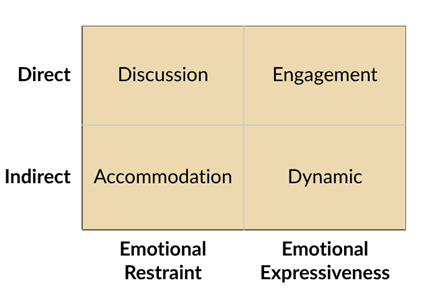
The centerpiece of the morning was the ICS Inventory, a validated tool that maps individual conflict approaches across two dimensions: how direct or indirect you tend to be, and how emotionally expressive or restrained. Neither axis is better. What reads as avoidance to one person reads as respect to another. What reads as aggression to one person reads as honesty to another. Without language for it, people fill the gap with assumptions about character and intent.
Most Conflict Isn’t Personal: Using GRPI to Find the Real Source
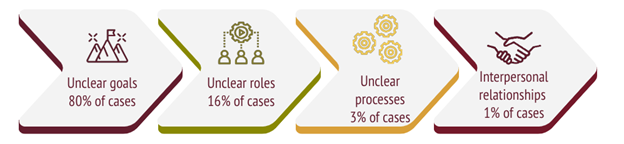
After lunch we worked through the GRPI (Goals, Roles, Processes, Interpersonal Relationships) model as a diagnostic framework. The model operates hierarchically: ambiguity at a higher level cascades down and produces friction that looks personal. About 80% of workplace conflict traces back to unclear goals. That number tends to land hard in rooms full of public sector employees who have spent years convinced that their hardest conflicts were fundamentally about relationships, when they were actually about goal or role clarity that was never established.
Transactional, Relational, or Symbolic? Why the Level Matters
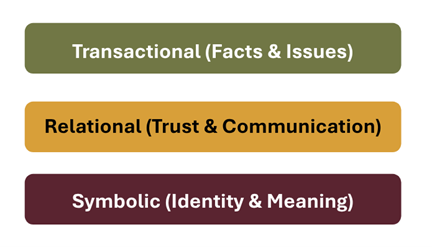
We also worked through Michelle Le Baron’s Three Dimensions of Conflict framework, which asks a different question than GRPI. Where GRPI helps you locate where conflict lives structurally, the three dimensions help you understand what level it’s operating on.
- A transactional conflict is about facts and issues like a missed deadline, a disputed resource, or a policy disagreement.
- A relational conflict is about trust and communication patterns.
- A symbolic conflict runs deeper, touching identity, values, and what a situation means to the people in it.
Applying the wrong intervention to the wrong level is one of the most common reasons conflict resolution fails. Addressing a symbolic conflict with a policy clarification, for example, will usually make it worse.
That’s true in the private sector. It’s just as true in government, where you often can’t buy your way out of a capacity problem and culture is one of the few levers you actually control.
No Single Model Works for Everyone
I deliberately covered multiple models because not everyone finds the same framework useful, and people are more likely to actually use a tool in a difficult moment if it makes sense to them. Mindfulness, the ICS, GRPI, and the three dimensions each address a different part of the problem. Used together, they give people more than one way in.
We closed with scenarios drawn from the real texture of state agency work:
- A vendor contract stuck in legal review while another department watches a deadline approach.
- A conference room that wasn’t set up because a work order didn’t meet the 48-hour policy.
- A code violation in a workspace that had operated that way for years.
Each one gave the group a chance to practice applying the frameworks in a familiar context.
By the end of day, the majority of participants rated themselves comfortable or very comfortable with conflict. At the start of the day, less than a third had. For some people the entry point was GRPI, a clean, rational framework that reframes interpersonal friction as a structural problem. For others it was the moment that participant stood up and named our common humanity. Not every person needs the same entry point, and my goal is to make sure there’s a door for each of them.
That’s true in the private sector. It’s just as true in government, where you often can’t buy your way out of a capacity problem and culture is one of the few levers you actually control.
Kai Stowers (he/him) is an executive coach, facilitator, and organizational consultant with an MA in Organizational Psychology and Change Leadership from Columbia University and an ICF PCC credential with over 1,000 coaching hours. He works with leaders in government agencies, nonprofits, and entrepreneurial organizations using validated tools including the Hogan Assessment Suite, Leadership Circle Profile, and Intercultural Conflict Styles Inventory. He brings nearly 20 years of mindfulness practice into every engagement. When he’s not working, he plays goalie for an adult ice hockey league.
Get the right support for your team.
CPS HR partners with public sector organizations to improve performance through facilitation, validated assessments, and leadership coaching
Learn moreReady to learn more? Explore related resources:


Find Out How
CPS HR Consulting Can Help You
Every business has unique HR needs. Working together we’ll find the right solution to achieve your goals.
Connect with an HR Professional