
Classification & Compensation
Solutions
Build role clarity. Ensure pay equity. Strengthen workforce sustainability.
CPS HR Consulting delivers classification and compensation services designed exclusively for public sector organizations. Drawing on more than 40 years of experience serving government and nonprofit agencies, we help clients create clear job structures, equitable pay systems, and defensible HR practices that support long-term organizational performance and public trust. Our services can be delivered as standalone engagements or as an integrated classification and compensation study, depending on your needs, timeline, and budget.
Explore our Solutions:
CPS HR’s compensation studies help public agencies attract, retain, and motivate talent while maintaining fiscal responsibility. We analyze market data, internal equity, and organizational goals to ensure compensation structures are fair, competitive, and aligned with your compensation philosophy.
Our compensation services support:
- Informed decision-making through clear, actionable recommendations
- Market competitiveness across benchmark classifications
- Pay equity and compliance with applicable regulations
- Sustainable salary structures that support recruitment and retention
Our work provides agencies with the insight needed to manage compensation strategically—balancing affordability with the need to recruit and retain a high-performing public workforce.
Concerned about pay equity, market alignment, or compression? Start a compensation conversation.
Our classification studies establish a strong foundation for effective human resource management by ensuring jobs are accurately defined, aligned internally, and reflective of the work performed. CPS HR evaluates classification systems at the individual position, class series, department, or enterprise-wide level, tailoring each engagement to the scope and complexity of the organization.
Our classification services help agencies:
- Improve role clarity and accountability through well-defined job specifications
- Support workforce planning and organizational design
- Ensure internal alignment and defensibility of classification decisions
- Reduce compliance and classification-related risk
Our consultants apply proven methodologies, informed by deep public sector expertise, to deliver practical and transparent outcomes that stand up to audit, appeal, and stakeholder scrutiny.
Need clearer job definitions or defensible class structures? Talk with a classification specialist.
Integrated Classification & Compensation Solutions
Because classification and compensation are inherently interconnected, many clients choose an integrated study that examines job structure and pay relationships together. This approach ensures that classification decisions directly inform compensation outcomes, resulting in a cohesive and defensible framework.
An integrated approach enables agencies to:
- Align job roles, career paths, and compensation structures
- Address internal equity and market competitiveness simultaneously
- Reduce implementation risk and stakeholder confusion
- Maximize the value of the study through coordinated analysis and recommendations
Integrated studies are especially effective for agencies undergoing organizational change, workforce growth, or heightened scrutiny around equity and transparency.
Considering a comprehensive study? Learn whether an integrated approach is right for your agency.
Frequently Asked Questions
A classification and compensation study is most effective when started well before the organization needs to act on the results. These studies require planning, employee participation, data collection, analysis, and review, and building in adequate lead time helps support a more thorough and defensible outcome.
Depending on the scope and complexity of your study, the process can take anywhere from a few months to a year or more. Factors that can affect the schedule include the number of classifications under review, the size of the workforce, the number of benchmark positions and comparator agencies, whether the study includes classification work, compensation work, or both, and the timing of PDQ completion and review.
Many organizations begin studies in advance of key decision points such as budget development, labor negotiations, reorganizations, or policy updates. Others move forward when they begin to see signs that their structure or compensation program may no longer align with operational needs, recruitment and retention challenges, or market conditions.
Starting early provides time for thoughtful analysis, stakeholder review, and implementation planning. Compressed timelines can limit opportunities for validation and review and may affect the depth of the analysis that supports the final recommendations.
Classification Studies FAQ
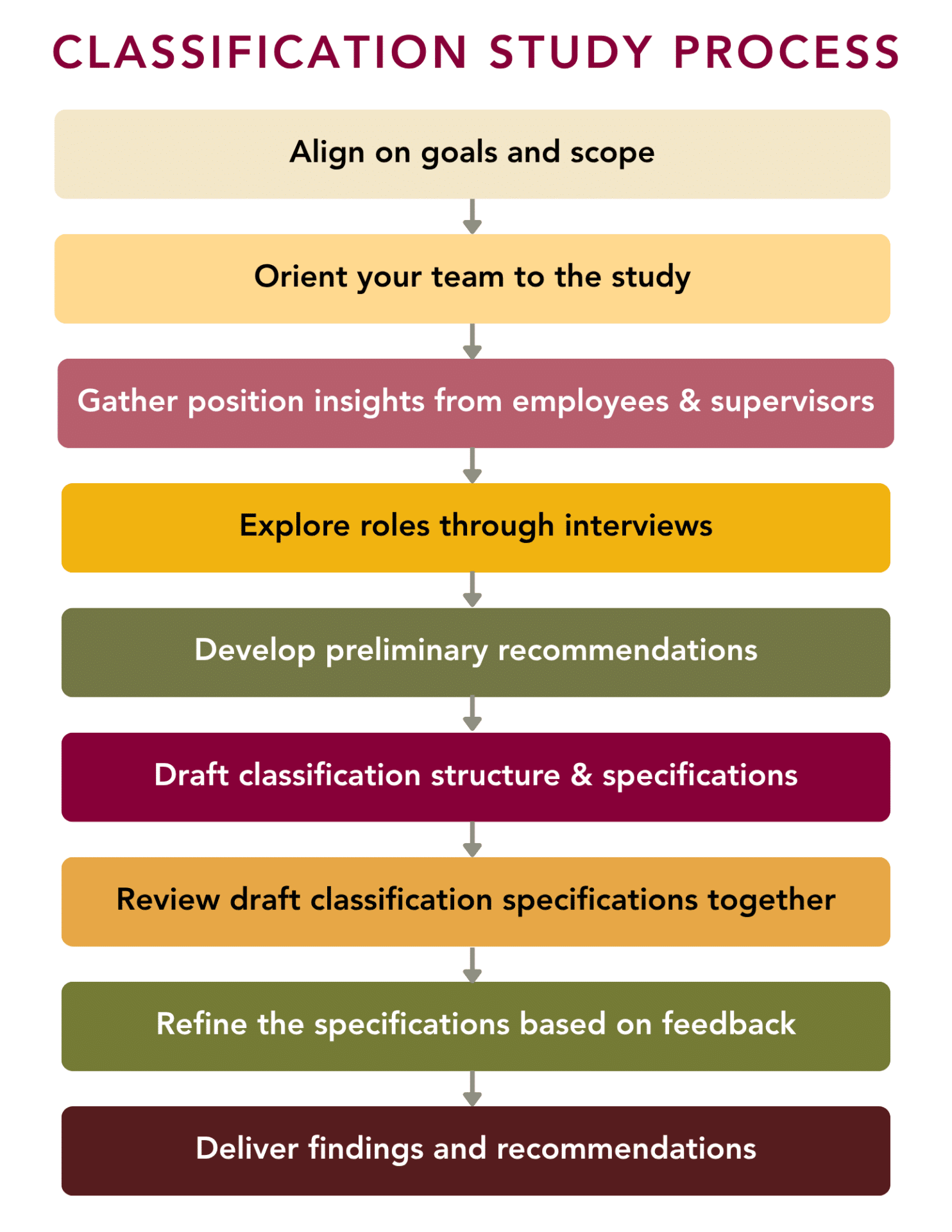
A classification study generally starts with a project kick-off and parameters memo, followed by an orientation session introducing incumbents and supervisors to the study.
Then Position Description Questionnaires (PDQs) are administered, and interviews with incumbents and supervisors are conducted.
From there, CPS HR analyses the information and creates classification structure recommendations and updates or develops classification specifications.
Allocation recommendations, physical requirements review, and classification-based Fair Labor Standards Act (FLSA) review can also be part of the work.
Our approach is structured so the results hold up to scrutiny. We rely on PDQs and targeted interviews to validate job information, analyze each job as a whole (core duties, level of work, and minimum qualifications), and document assumptions and decisions clearly. Draft work products are shared for client review and refined based on feedback.
CPS HR conducts a classification-based review using the classification specifications and documented duties to inform exempt/non-exempt recommendations. We also help identify core functions and typical working conditions within the classification documentation.
A classification study generally produces a project parameters memo, draft and final classification specifications (in Word), an updated classification structure and crosswalk allocation recommendations, and a final written report covering methodology, findings, and recommendations. CPS HR also presents findings to executive leadership, labor stakeholders, or other groups.
We select incumbents and supervisors to interview to validate and clarify PDQ information and to understand role differences within and across classifications, as well as ensure appropriate representation in different program areas, departments, classification levels etc. Interviews may be targeted and focus on confirming core duties, level of responsibility, decision-making authority, and minimum qualifications, as well as any additional follow-up needed.
The client plays an important role in communicating expectations, reinforcing deadlines, and supporting supervisors during the PDQ review process. CPS HR provides the PDQ instrument and guidance and works with the client to keep PDQ completion on track.
Where allocations are part of the work, CPS HR develops recommendations based on the updated classification specifications and the job information collected during the study. Clients generally manage employee questions and the appeals process internally; CPS HR can assist with appeal review when scoped.
Each draft deliverable typically goes through one round of consolidated client feedback. CPS HR then reviews the feedback, confirms any open questions, and finalizes deliverables.
To start, we ask for current classification specifications, organizational charts, an employee roster, and any prior studies or policies that affect classification practices. We confirm goals, communication, and timing during the project kick-off.
Compensation Studies FAQ
CPS HR works with the client to confirm benchmark classifications and define an appropriate labor market. We can recommend comparable agencies based on factors like service scope, size, budget, and geography, with the client confirming the final list. Benchmarks are chosen with the client to make sure they’re a reliable basis for market matching.
CPS HR conducts both base salary studies and total compensation studies. Base salary studies focus on market pricing using salary range minimums and maximums. Total compensation studies add employer-paid benefits and cash add-ons to show overall competitiveness.
CPS HR primarily uses published salary schedules and related public documents and follows up with comparator agencies when clarification is helpful. For total compensation studies, we collect employer-paid benefit elements and cash add-ons using a consistent template and document our sources.
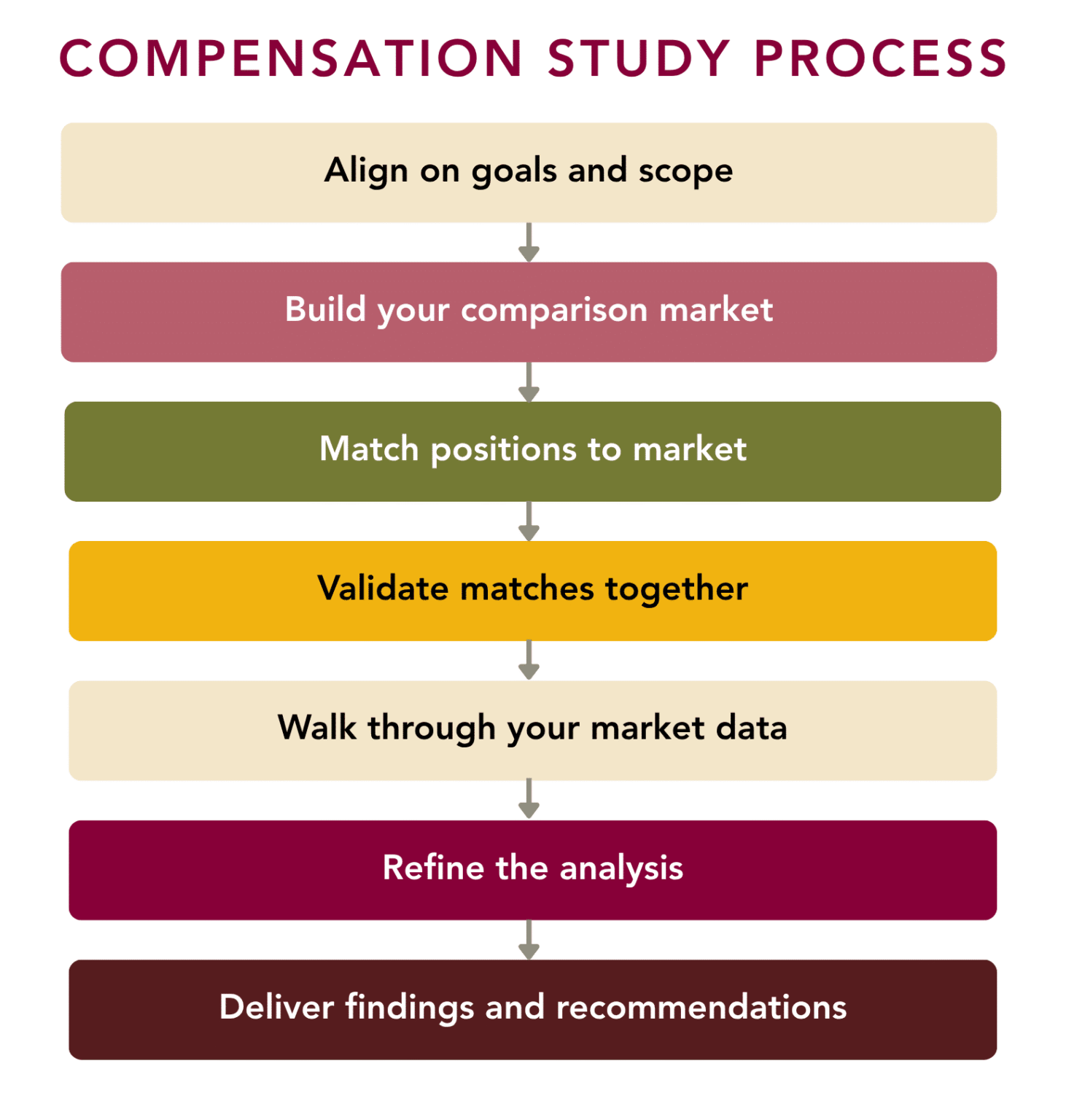
Our methodology is structured so the results hold up to scrutiny. We confirm goals and market positioning, define benchmark classifications and the comparator pool, use whole-job analysis to match benchmarks to the market (looking at core duties, level of work, and minimum qualifications), share draft matches for client review, and complete a quality assurance audit before finalizing results and recommendations.
CPS HR develops draft matches using whole-job analysis, drawing on class specifications, organizational charts, and other documentation. Draft matches go to the client for review and feedback, then we refine them and finalize the set before running market calculations and recommendations.
Compensation studies include an internal alignment review to look at job relationships and pay structure alongside external market data. This typically includes classification-level analyses like range penetration/compa-ratio summaries and identification of potential compression concerns. An incumbent-level pay equity audit is a separate engagement when requested.
A compensation study generally produces a project parameters memo, draft and final job matches, Excel market data sheets showing salary range minimums and maximums for matched benchmark positions, and — for total compensation studies — benefits tables. The work also includes recommended salary range adjustments, compensation structure updates, and a discussion of implementation. CPS HR provides a final written report and presents findings to executive leadership, governing bodies, labor stakeholders, or other groups.
Recommendations bring together external market data, internal alignment, and the client’s desired market position (for example, lag, meet, or lead). For structures, CPS HR looks at pay grade relationships, range spreads, and separation between grades to support a structure that is internally consistent and aligned with the market. We also walk through implementation options and timing.
To start, we ask for current salary schedule(s), benefit summary/cost information (for total compensation studies), a list of benchmark classifications, and any relevant compensation policies, MOUs, and pay practices. We confirm the study’s effective date and the client’s market position and implementation goals during the kick-off.
CPS HR provides implementation support and guidance on timelines, communication, and sequencing. We also share maintenance guidelines and offer training to help your team interpret the deliverables, keep documentation current, and apply the results consistently over time.
CPS HR can structure work in phases — for example, labor market research first, then benchmarking, then recommendations — or support agencies under on-call/not-to-exceed agreements. This gives agencies flexibility on timing and budget.
Flexible Engagement Models
Standalone, integrated, or ongoing support.
CPS HR offers flexible delivery models to meet agencies where they are:
- Standalone classification or compensation studies for targeted needs
- Integrated classification and compensation studies for comprehensive solutions
- On-demand and ongoing agreements for reclassifications, updates, and advisory support
Each engagement is scoped based on the number of classifications, incumbents, organizational complexity, and timeline – ensuring a right-sized, cost-effective solution.
Why CPS HR Consulting
- Exclusive focus on public sector and nonprofit organizations
- More than four decades of classification and compensation experience
- Proven, defensible methodologies tailored to government environments
- Consultants who understand compliance, labor relations, and public accountability
We don’t just deliver studies—we provide clarity, confidence, and practical solutions that help public agencies serve their communities more effectively.