
Training Doesn’t Change Team Behavior, Clear Expectations Do
In my nearly two decades of leading learning programs, I have met with countless operational leaders who looked to training as a “fix” for issues, behaviors, and performance gaps on their teams.
The common misconception in employee development is that an instructive workshop or a high-energy training session is the magic wand that, once waved, will automatically result in a more efficient or cohesive team. However, the reality of organizational growth is far more grounded. Training provides the spark, but true behavior change is forged in the real world, through real people and real situations.
To maximize any investment in people, we must shift our perspective from seeing training as a one-time repair to viewing it as a continuous cycle of growth. This transformation relies heavily on the habit of clarity, perhaps the most important discipline a leader can master.
When leadership is clear about what matters, the team tends to mirror those values, turning a simple learning experience into a lasting partnership for success rather than a temporary patch for a deeper problem.
The Leadership-Learning Partnership
The true bridge between the classroom and the workplace is the partnership between the participant and their direct supervisor. Learning is not a solo journey—it is a partnership. It is a collaborative effort where the skilled supervisor plays the most crucial role in a team member’s growth.
For a training initiative to bring about meaningful change, senior leadership must set the stage by clearly communicating expectations not just to the learning participants, but to the managers who will oversee them. This begins with a “Leadership Intent” memo that explicitly connects the training to organizational goals. Fundamentally, this memo must provide supervisors with the “permission” to prioritize coaching over immediate output.
By defining the strategic “why” behind the learning initiative, senior leaders empower supervisors to take ownership of their role as the primary drivers of learning and skill application, ensuring that development is not treated as a distraction from work, but as the work itself.
From Passive Observers to Active Coaches
To ensure a learning experience succeeds, leadership must engage direct supervisors early by setting clear expectations for how they will support their teams. Rather than leaving this involvement to chance, the organization must define the specific actions supervisors should take to champion new skills. This proactive approach prepares managers to facilitate the transition from classroom to workplace, shifting their role from passive approval to active reinforcement.
Through dedicated supervisor briefings, managers become active coaches ready to assist their team members in applying new competencies. These briefings provide supervisors with the exact language and “cheat sheets” needed to strengthen specific skills, ensuring they have the tools to bridge the gap between training and performance.
This early alignment ensures that when a team member returns to their desk, they aren’t met with the crushing weight of backlogged emails, but rather with a leader ready to engage through skillful dialogue.
This transition is marked by guided inquiry, where the supervisor moves beyond asking “How was the class?” to deeper questions like, “Which specific tool from the session do you see having the most immediate impact on our current project?” or “What is one obstacle you anticipate while practicing this new skill, and how can I help you clear it?”
By facilitating this intentional conversation, supervisors are better equipped to establish clear success metrics—documented, observable behaviors or KPIs—that serve as a practical roadmap. This collaborative clarity removes the guesswork for the employee, transforming the return to work into a supportive environment where new skills are not just expected, but actively nurtured and measured through a shared commitment to growth.
The Catalyst for Change
Once the groundwork is laid, the learning experience serves as the catalyst for introducing new concepts. It is essential to treat the classroom as a safe harbor for iteration and failure, but the investment is only successful when it translates into immediate momentum.
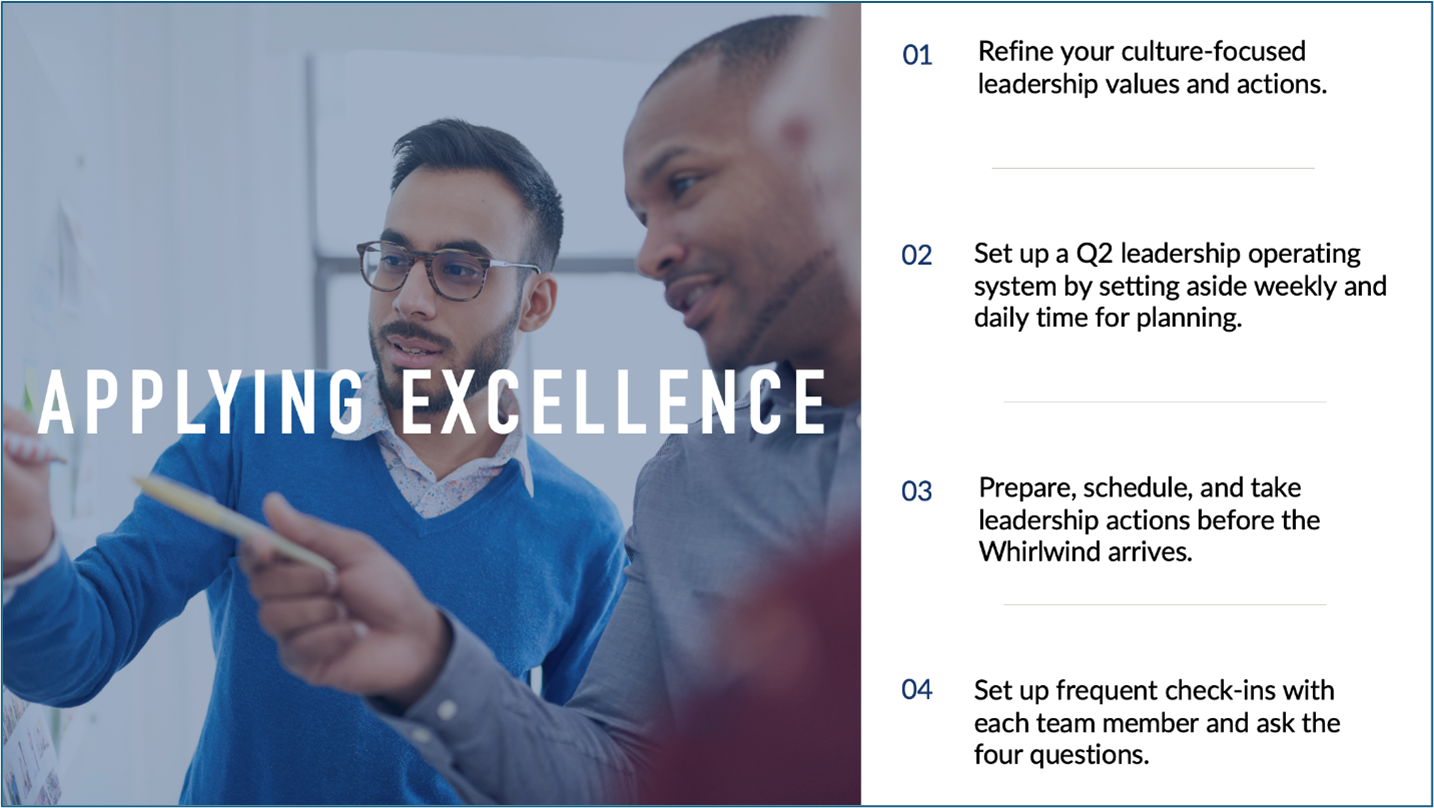
I regularly conclude my learning experiences with a final slide titled “Applying Excellence,” which serves as a direct call to action. I emphasize to the group that to make their investment of time and energy truly worthwhile, they must bridge the gap between the classroom and the workplace immediately upon returning to their desks.
To facilitate this, I simply transform my course objectives into 3–5 specific, actionable steps. In this moment, I prioritize clear direction over theory, ensuring every participant leaves with a concrete roadmap for what they need to do next.
Here is an example:
To bridge the gap between theory and practice, participants commit to taking specific, high-impact actions within their first 48 hours back on the job. This rapid transition from the classroom to the floor is vital to ensure the “forgetting curve” never has a chance to set in.
By executing these 48-hour actionable objectives as collaborative milestones, the employee creates the perfect opening for their supervisor to provide feedback and reinforce new behaviors before old habits can resurface.
Sustaining Excellence in the Real World
The most critical work happens after the session ends, where the partnership is put to the test against the daily “tension of the desk.” To prevent learning decay, leaders must manage the workload to allow for ongoing engagement. This is facilitated by scheduling “post-game” one-on-ones a week after the training to address obstacles and celebrate progress.
Creating a peer accountability loop, such as a thirty-day follow-up for the cohort, further solidifies these new habits. Finally, to close the loop and demonstrate tangible impact, a measurement mechanism should be deployed at the 60- or 90-day mark.
Ultimately, the measure of professional development is not the quality of the slides, but the tangible change that takes root in the months that follow. True excellence is never a solo pursuit. It is a sustained, supported action fueled by a culture of accountability.
When senior leaders commit to the habit of clarity and supervisors embrace their role as active coaches, they transform a simple training event into a permanent shift in how the team operates, excels, and succeeds together.

Brian Bullock is the Training and Development Manager at CPS HR. He has over 17 years of experience designing, developing, and facilitating transformational learning experiences for leaders at all levels across various industries.
Brian’s public sector roles included serving as the Managing Director of Worldwide Learning and Professional Development at the International City/County Management Association, Manager of Instructional Design at the University of Nevada, Las Vegas, and Manager of Learning and Development for the City and County of Denver, CO. Brian earned a master’s in educational media and technology from Boston University and a bachelor’s degree in social science and anthropology from New York University. When not at work, Brian enjoys traveling with his wife, rooting for Vegas and Boston sports teams, and rocking out at concerts.
Ready to learn more? Explore related resources:



Find Out How
CPS HR Consulting Can Help You
Every business has unique HR needs. Working together we’ll find the right solution to achieve your goals.
Connect with an HR Professional